

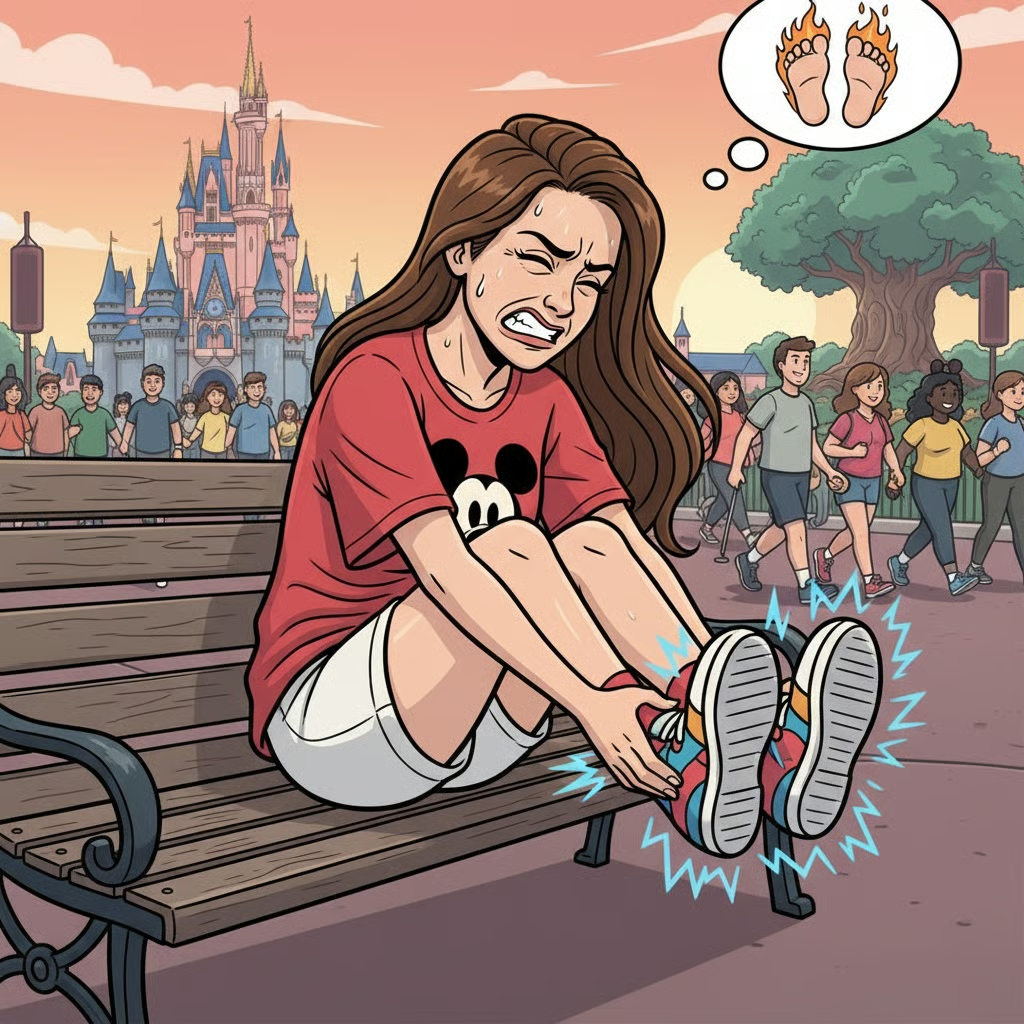
You’re going to want to steal this blueprint for plantar fasciitis rehab.
If you’re planning your next Disney trip, but you’ve been dealing with stabbing pain on the bottom of your foot, you’re not alone. As much as 10% of adults may experience plantar fasciitis over their lifetime. And about 2 million Americans seek treatment for plantar fasciitis every year.
But what exactly is plantar fasciitis? How do you improve your pain so you can enjoy walking at Disney? And most importantly, can you still do Disney even if you’re dealing with plantar fasciitis? (HINT: yes, you certainly can!)
From a Doctor of Physical Therapy who’s helped thousands of patients gain back their lives, here’s what you need to know about plantar fasciitis so that you can effortlessly walk at Disney.
How to Differentiate Plantar Fasciitis From Other Foot Issues
The last thing you want to do is mistake plantar fasciitis for another injury, losing you precious time as you prepare for your next Disney vacation.
But if you also leave plantar fasciitis untreated, it can put an abrupt end to your day at Disney. So how exactly do you know if you have plantar fasciitis in the first place?
As a Doctor of Physical Therapy, here are the most common symptoms of plantar fasciitis I’ve found in my practice:
- Pain at the inside of the bottom of the foot, just in front of the heel bone
- Pain that feels worse with the first steps in the morning, but gets better soon after
- Pain that feels worse with the first steps after sitting for a while, like after sitting down for a meal
- Generally improves with some activity, but gets worse at the end of the day (after a lot walking or after prolonged sitting (after sitting down for a meal)
However, if you’re feeling any of the following symptoms, you might actually be dealing with a different type of injury:
- Pain at the back of your heel
- Numbness or tingling in the painful foot or numbness or tingling going down one leg
Having these symptoms likely requires a different rehab plan.
Finally, there are some symptoms that if you experience them, may require a closer look by a physician and/or imaging to rule out anything serious. They include:
- Acute trauma such as a fall, followed by sharp foot pain and the inability to walk
- Foot pain that continues to get worse the more you stand, walk, or run
- Unrelenting night pain
- The inability to point your toes
- New onset of numbness and tingling going down both legs
- Severe disability
If you experience any of these symptoms, you should check with your physician to ensure that you’re not dealing with something more serious.
Why Does Plantar Fasciitis Happen with Walking or Standing?
Believe it or not, the plantar fascia plays a crucial role in your body’s ability to walk all day at Disney.
Made of dense fibrous connective tissue, the plantar fascia connects your deep foot muscles to your Achilles tendon and calf and helps support your foot’s arch. With this connection, the plantar fascia efficiently transfers and releases energy with every step. That means that a healthy, functioning plantar fascia allows you to walk effortlessly all day at the Disney parks and with more energy in the tank.
However, with plantar fasciitis, the plantar fascia was repetitively stressed far beyond what it could handle, which weakened the structure of the connective tissue. This makes it much more difficult for the plantar fascia to transfer and release energy when walking.
The reason your foot hurts with standing and walking is because your plantar fascia is under the most stress during weight bearing and calf loading.
A few years ago, I was running late for work because I accidentally slept through my alarm. Inevitably, I was stuck in traffic, surrounded by a sea of honking cars. Frantically running into the clinic, I was late for my first patient’s appointment, who greeted me by telling me how much I wasted their time. After running behind for my next four patients, I finally had a break, when my coworker noticed my grumpy face.
Trying to cheer me up, they told me, “Smile a little!”
What’s normally a harmless statement under different circumstances would have made me chuckle a little. But instead, under the pressure of the previous chain of stressful events, I ended up blowing up in anger at my well-intentioned coworker.
Your plantar fascia reacts in the same way.
When stressor after stressor after stressor acts upon your plantar fascia, it’s only a matter of time before it gives into that added stress.
Can Plantar Fasciitis be Healed?
It most certainly can, but there are a few things to be aware of.
First, researchers found that most cases of plantar fasciitis improve within 6-12 months, but chronic cases are common. Additionally, researchers found that it’s common for plantar fasciitis to come back after improving. And on top of that, it’s common for symptoms of plantar fasciitis to fluctuate.
So while many people do fully recover from plantar fasciitis, some deal with it much longer than others. For example, if your job involves you standing all day or if you participate in a running sport and can’t take a break from it, your rehab timeline will be longer than someone who can spend less time on their feet everyday.
Even from what the research has taught us, there are still a lot that you can do to either recover from plantar fasciitis or manage plantar fasciitis so you can still walk comfortably all day at Disney and stand in long lines to ride your favorite attractions.
Plantar Fasciitis Myths
There are a lot of faulty beliefs when it comes to plantar fasciitis, so let’s be sure to clear the air.
Myth #1: You Need an X-Ray for Plantar Fasciitis
Imaging is generally not needed unless you experience the following symptoms:
- A traumatic event before your pain started
- Unrelenting night pain
- Severe disability
- The inability to point your toes
- New onset of numbness and tingling going down both legs
Oh, and by the way, heel spurs are not the cause of plantar fasciitis. Believe it or not, heel spurs are usually an incidental finding on x-rays and are typically not the cause of foot pain.
Myth #2: Rest is the Best Treatment for Plantar Fasciitis
If rest was the cure for plantar fasciitis, I’d be out of a job as a Doctor of Physical Therapy.
A healthy, functioning plantar fascia is the result of exposing all the tissues of your foot to the right amount of stress, letting it rest and recover, then gradually exposing it to higher amounts of stress over time. Expose it to too much stress for a prolonged period of time, and you’re likely to get plantar fasciitis. However, expose it to too little stress (or no stress at all), and your plantar fascia only gets weaker.
Complete rest only results in a weaker plantar fascia, making it even more difficult for you to stand and walk at Disney.
Also remember that avoiding all pain isn’t necessary when recovering from plantar fasciitis. Keeping your pain levels within a tolerable range (more on that below) while still doing your daily routine sets you up for a speedier recovery and more enjoyable vacation at Disney.
You’re far better off experimenting to learn how much activity is too much for you and how much is too little so that you can gradually strengthen your plantar fascia and get back to doing what you love (also more on that below).
Myth #3: Plantar Fasciitis is Genetic or Only Caused by Flat Feet
Actually, there is no gene that codes for plantar fasciitis.
Additionally, plantar fasciitis can still occur in people with high or medium arches. Besides, if plantar fasciitis was only caused by flat feet, it’s hard to believe that plantar fasciitis is some dormant condition that decided to come out of hibernation after forty years of living on this earth.
Instead, think of plantar fasciitis as the result of your plantar fascia being repetitively stressed far beyond what it could handle, weakening the structure of the connective tissue.
Myth #4: Corticosteroid Injections are the Best Treatment for Plantar Fasciitis
While corticosteroid injections are certainly an option to treat plantar fasciitis, they shouldn’t be your first line of defense.
Research found that corticosteroid injections may help reduce short-term symptoms (4-6 weeks) but don’t offer any long-term advantage. This is because corticosteroid injections don’t strengthen your plantar fascia the way exercise can. Corticosteroid injections may be a quick fix for the pain, but if your plantar fascia doesn’t become resilient, standing and walking at Disney will still be painful.
I recently saw a post on a popular Disney theme parks Facebook page asking what people use for foot pain after a long park day. Every single answer included things like ibuprofen, Bengay, epsom salt baths, biofreeze, Voltaren, Salonpass, Aspercreme, rolling a frozen water bottle, and topical lidocaine. All great options to reduce foot pain after a full day of walking at the Disney parks.
And while this advice is well-intentioned (one response even came from the wife of a foot and ankle surgeon), every single one of these treatment options don’t get to the root of the problem: the fact that your plantar fascia was stressed far beyond what it could handle. Don’t get me wrong, treatments like epsom salt baths, rolling a frozen water bottle or tennis ball still work great as a recovery tool after a long day of walking at Disney.
But if you’re dealing with plantar fasciitis and you’re planning a Disney trip (which, by the way, most plan their trip at least 6 months in advance), you’re far better off taking the time to rehab your injury so you have less pain walking at Disney.
Your 4 Step Plan to Recovering From Plantar Fasciitis
Here’s the 4 step plan to recover from plantar fasciitis so you can walk effortlessly through your next Disney vacation.
- Start Rehab as Soon as Possible
If you’ve been dealing with plantar fasciitis symptoms for over a year, it’ll likely take much longer to recover versus if you had symptoms for a few weeks.
The earlier you start your rehab process, the sooner you can figure out what treatments work best for you. A trusted physical therapist can help figure out exactly which treatments work best for you. However, the following exercises usually make their way into my rehab plan with my clients:

Plantar Fascia Stretch (2-3x/day): start with shorter holds of 10-20 seconds, increase holds as you’re able to tolerate

Heel raise (3 sets, 8-12 repetitions): start with double leg heel raise, progress to a heel raise with your big toe over a towel roll
With both of these exercises, it’s important to monitor how your body responds the next day and to progress as you’re able to tolerate.
- Choose the Right Footwear for You
Like the type of shoes I’d recommend for the Disney parks, the best shoes while recovering from plantar fasciitis are the shoes that are most comfortable for you.
Usually, that means that:
- There should be a thumb’s width between the front of your big toe and the end of your shoe
- You should be able to wiggle your toes when standing in your shoes
- You should have enough width for your feet
- Your heel should fit snug and shouldn’t slip out when walking
- Your ankles shouldn’t roll side-to-side
Shoes such as Hokas and Altras are great shoe options to explore because they offer shoe models with wide toe boxes – a great feature that can put less stress on your plantar fascia when walking at Disney.
Additionally, shoe inserts may work well to relieve pain. Research has even found that over-the-counter shoe inserts work just as well with custom shoe inserts. So, you should experiment with over-the-counter inserts before considering a custom-made one.
If you have a lot of pain with your first few steps in the morning, consider wearing a night splint. Night splints work by gently stretching the plantar fascia and Achilles tendon, preventing them from tightening while you sleep. They also pack well, making it easy to bring with you to Disney.
Whether it’s footwear or night splints, it’s important to consistently use both for the most effective recovery.
- Modify or Temporarily Remove the Biggest Aggravators
That doesn’t mean that you should completely rest though! (see myth #2)
This is why it’s important to listen to your body. With movements that aggravate your pain, take the time to learn the specific point your pain gets significantly worse. Then, modify that movement to what’s tolerable for you. Here are a few examples of what you can do to modify your movements:
- If standing makes your pain feel worse, figure out how much time it takes for your pain to get significantly worse. Take sitting breaks before your pain spikes. Consider using an anti-fatigue mat at work for pain relief or using shoes with more cushion when going to the Disney parks
- If walking makes your pain feel worse, figure out how long or at what speed it takes for your pain to get significantly worse. Take sitting breaks before your pain spikes, decrease your walking speed, or change your walking surface for pain relief
Remember, avoiding all pain isn’t necessary. With the right rehab program, your pain should be tolerable and gradually decrease over time. The general rule is to keep your pain levels ≤3–4/10 during activity with your pain decreasing to a 0/10 the day after.
- Track Your Progress by Function, Not Just Pain Levels
Pain level is the most popular way to track progress among patients.
It’s typically the first thing my patients think of. Rightfully so, since pain is the reason they’re having difficulty doing the activity they love to do. It’s literally the first reason they come to see me in the clinic.
However, you’d be leaving a lot on the table if you only tracked pain levels.
When working with my patients, I use a lot of different ways to track progress. Pain levels are just the tip of the iceberg. A much more effective way to track your progress involves connecting your pain levels with a functional task – standing, walking, running, etc. Here are a few things I advise my patients to track:
- How long it takes for your pain to spike when standing
- How many steps it takes before your pain spikes when walking
- Your pain level during your first steps in the morning
Once you have your baseline measurements, gradually increase your standing or walking time by 5-10% every week. Remember, the general rule is to keep your pain levels ≤3–4/10 during activity with your pain decreasing to a 0/10 the day after.
If you connect your pain levels with a functional task, progress could look like the following:
- Before, it would take 5 minutes of standing before your pain spikes, but now it takes 15 minutes
- Before, it would take 3,000 steps before your pain spikes, but now it takes 5,000 steps
- Before, you had 7/10 pain in the morning, but now it’s 4/10
Pain levels are just one piece to your puzzle.
Any questions? Make sure to send me a message – I’m more than happy to help!
No responses yet