

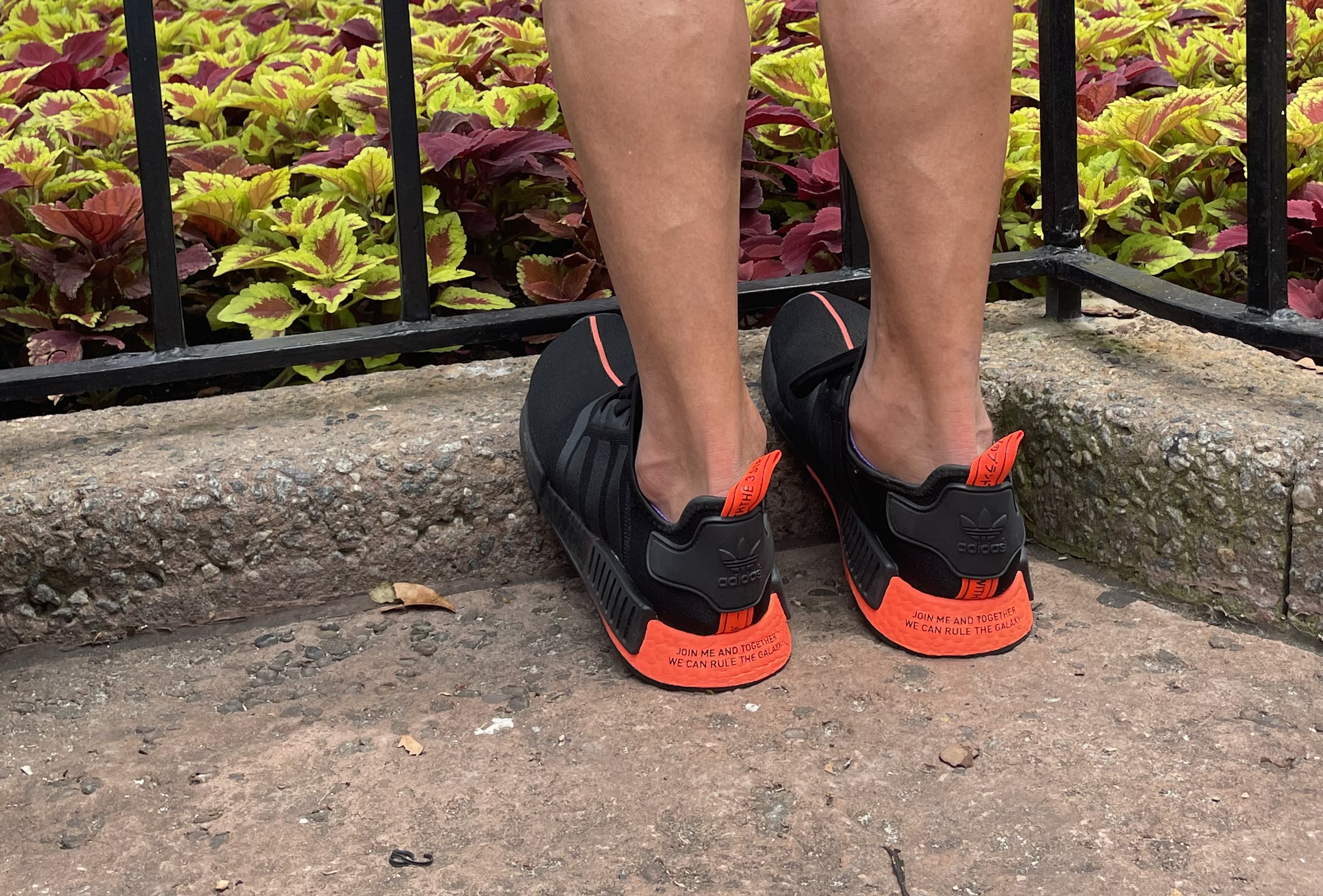
Choosing the right pair of walking shoes can feel like the most daunting task. Walking into a shoe store can sometimes feel like walking into the World of Disney store to look at their Minnie Mouse Ears. There’s. So. Much. To. Choose. From.
Ironically, it’s a wonderful thing to have a variety of shoes to choose from.

Just like how there’s no one pair of Minnie Mouse ears for everyone (or Disney pins for those of you who prefer to go ear-less), there’s no one pair of walking shoes for everyone (Why do you think the glass slipper only fit Cinderella?). Everybody is different, and I don’t just mean their personalities. Everybody’s body is different, and their feet are no exception. The wider the range of shoes available to you, the more likely we can match a particular shoe to a person with a specific need at a specific time. More variations = more options!
With that said, I want you to have the smoothest possible experience when picking out your walking shoes. Here are my top 6 tips for finding the best walking shoes for you!
If you like what you read, go ahead and like my post and share it with your friends. If you have any suggestions, comments, or ideas you would like me to blog about in the future, feel free to leave a comment down below!
MYTH: You Need to Match Your Shoe to Your Foot Type
This tip is so important that 1) it’s the title of this section, and 2) I’m going to write it again: there is no need to match your shoe to your foot type. Researchers have found that selecting running shoes based on arch height had little influence on injury risk.
I don’t find much value in having a shoe salesman taking a heat map of your feet and analyzing your barefootgait. As we mentioned earlier, everybody’s feet are different. Just because your arch is higher, lower, or more neutral when you’re standing does not predict how it will be when you’re walking. On top of that, your gait (ie. Your walking mechanics) when you’re barefoot may be drastically different from your gait in a pair of comfortable shoes. For my flat footers out there (like me!), research has found that pronation isn’t necessarily associated with injury risk and footwear may not alter the biomechanics of our feet.
Besides, you’re better off strengthening your feet and ankles so you can go through your parks day with more ease.

You’re much better off choosing a shoe that’s comfortable versus choosing a shoe with more arch support, motion control, etc. Researchers have found a correlation between general shoe comfort and rate of injury occurrence. So, a more comfortable shoe will likely help you utilize a normal gait pattern.
Shoe Considerations
Should you get walking or running shoes? Well, it depends. Your typical walking shoe and typical running shoe are built differently. Running shoes usually have more cushion whereas walking shoes do not have extra material at the heel. Theoretically this is done so that the shoe doesn’t alter the way your heel strikes the ground with walking.
Does that extra cushioning matter for you? It depends (I hope you see a theme here!). More cushioning may be more comfortable if you’ve had foot or ankle injuries in the past. Shoes with less cushion (and entering into the realm of minimalist shoes) have been found to place less load on the knees while walking.
What about shoe drop (the difference in height between the heel and the toe)?
Everybody now: it depends!
Shoes with higher drop height may contribute to higher loads at the knee, which is counterintuitive to conventional beliefs. So, a shoe with less cushion and lower drop height may be more comfortable if you’ve had knee injuries in the past.
Go For a Test Walk!
With all things considered, it’s important that you test out a multiple pairs of shoes at the store. Try different brands and shoe types. Heck, try different shoes on each of your feet to compare shoes simultaneously. Because all shoe brands use different molds, they have slight variations in their sizing. Shoe brands may also have slight variations between models. Sometimes, the same shoe model can vary from year to year!
When trying shoes, look for any rubbing against your feet, any discomfort, or sore spots that would signal you to try something else.
I can’t stress this enough: try different brands and different shoe types. As we mentioned earlier, there’s no need to match your shoe to your foot type. It may just so happen that your most comfortable pair of shoes doesn’t have arch support or that it doesn’t have as much cushion! Don’t let those different shoe types steer you away from them. Try them all.
Where Should I Go?
With so many shoe options available, it’s important to have someone knowledgeable about the current shoe market at your disposal. You’re more likely to have access to that person at a specialty running store. Specialty running stores also tend to carry only higher quality levels of shoes that are designed to last.
Don’t just stop there! It’s important to know what to ask. In addition to what we discussed above, you want to know what their fitting process is like. You also want to know what type of satisfaction guarantee they have on their products, in the case that you might not like the pair of shoes you buy.
Make sure to shop later in the day, since our feet tend to expand as the day progresses. You may even choose to go to the shop after a workout, when your feet expand even more. This ensures that your shoes fit well even at the end of a rope-drop day.
Oh, and please don’t forget about socks! When going to the shoe store, make sure to wear the socks you plan on using in the parks. The last thing you want is to buy a comfy pair of shoes only to find that your socks make your shoes feel too tight or too loose! Just make sure the socks are cotton-synthetic that wick away moisture, lightweight and breathable. For more advice on what type of socks to wear, check out my prior post on your ideal Disney parks outfit.
If the Shoe Fits…
Let’s talk how a shoe should generally fit around your feet. Let’s keep it simple and list out what you should know:
- There should be about a thumb’s width between the front of your big toe and the end of the shoe
- You should be able to wiggle your toes when standing in your shoes
- Ensure that you have enough width for your feet (read below)
- Your heel should fit relatively snug and shouldn’t slip out when walking
- Your ankles shouldn’t roll in the shoes
These guidelines allow for normal and healthy movement of your feet while you’re walking. As a result, your feet and its muscles will get good blood flow and nerve conduction, keeping them happy!
In regards to the third point, there’s a quick test you can do to make sure your shoes are wide enough for your feet. Pull out the insole of your potential shoe and stand on top of it with your full body weight. If any part of your foot sits outside of the insole, the shoe is likely not the right fit.
Special Considerations
From the most current research, there are a few recommendations we can make in regards to footwear if you are dealing with one of the following conditions:
For plantar fasciitis, rocker bottom shoes are recommended and foot orthoses may help with decreasing symptoms.
For patellofemoral pain, foot orthoses are recommended in the short term (less than 6 weeks) if they help reduce pain.
If you’re paying close attention to this section, you may be wondering why I haven’t talked about specific footwear or foot orthoses for other conditions. This is because there just isn’t enough evidence out there to make a strong enough recommendation. In this case, go with what’s comfortable.
Please remember that a proper fitting, comfortable shoe is not your most complete answer if you’re dealing with lingering body pains! If you have lingering pain, your body might be signaling that something needs to be addressed. Simply changing your shoe will not fix the issue. After all, the number one risk factor for sustaining an injury is having history of a previous injury. That is why I recommend seeing a physical therapist about your underlying issues to address them.
So there you have it – my top 6 tips for finding the best walking shoes for you. Remember, if you like what you read, go ahead and like my post and share it with your friends. If you have any suggestions, comments, or ideas you would like me to blog about in the future, feel free to leave a comment down below!
Remember, these are only suggestions. It’s always recommended that you speak to a medical professional about your particular situation before you travel.
3 Responses
[…] Shoes don’t make your Walt Disney World trip, but they can definitely break it. […]
[…] My Go-To Shoe for All-Day Comfort in the Theme Parks – Disney DPT on Your Comprehensive Guide to Choosing Your Disney Parks Shoes01/22/2024 […]
[…] Essential Plantar Fasciitis Rehab Tips for Your Disney Trip on Your Comprehensive Guide to Choosing Your Disney Parks Shoes11/05/2025 […]